➡️ INTRODUCTION
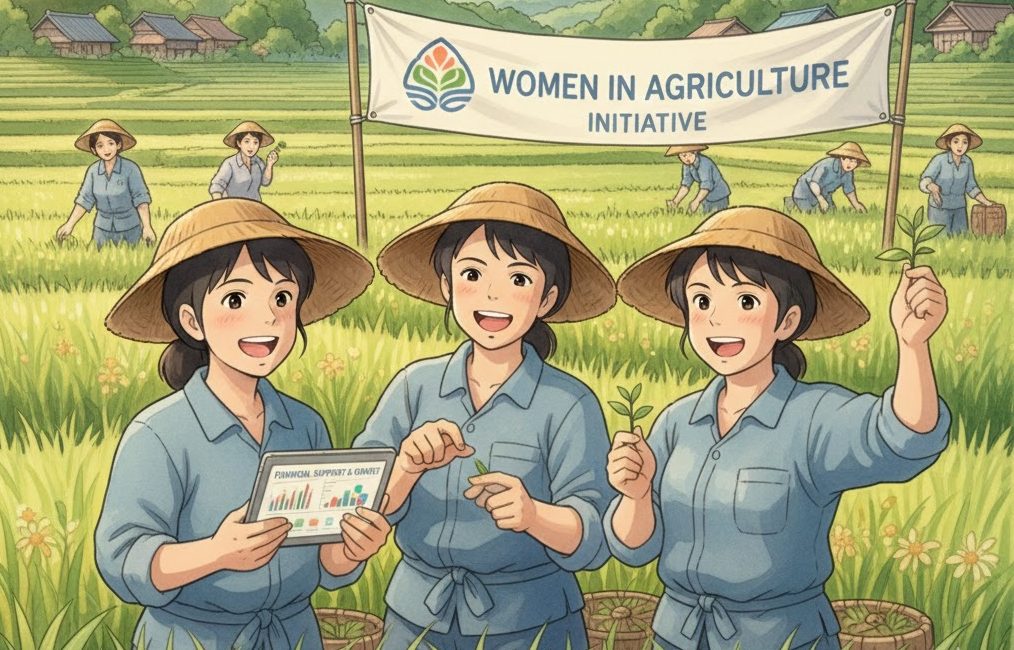
➡️ Women play a vital role in agriculture, contributing significantly to farming, livestock management, and food production. Despite their contributions, women farmers often face challenges such as limited access to land, credit, training, and technology. To address these issues, governments and organizations have introduced support schemes aimed at empowering women in agriculture. These programs provide financial aid, skill development, and access to resources, enabling women to enhance productivity and improve their livelihoods. By participating in such schemes, women farmers can adopt modern techniques, start agribusiness ventures, and make informed decisions about farm management. Empowerment programs not only improve economic independence but also contribute to social equity and sustainable development in rural areas.
➡️ Women farmers often face limited access to resources and credit.
➡️ Financial aid programs help reduce investment barriers for women in agriculture.
➡️ Training initiatives focus on skill development and modern techniques.
➡️ Empowerment programs enable women to participate in agribusiness and decision-making.
➡️ Support schemes contribute to social and economic development in rural areas.
➡️ Below are the key points explaining important women farmer support schemes.
🔵 1️⃣ ➡️ Financial Assistance Programs
➡️ Governments offer targeted financial assistance to women farmers to help them invest in seeds, fertilizers, equipment, and irrigation. These programs include subsidized loans, direct cash transfers, and grants, designed to reduce financial constraints. Access to credit enables women to start new farming ventures, expand existing operations, or adopt modern agricultural technologies. By easing capital limitations, these programs ensure that women can enhance crop yield, livestock productivity, and overall farm efficiency. Financial support not only boosts agricultural output but also improves economic independence, allowing women to contribute more effectively to their household income and community development.
🔵 2️⃣ ➡️ Skill Development and Training Programs
➡️ Training programs specifically designed for women farmers focus on improving knowledge and technical skills. These include workshops on modern farming practices, organic farming, crop diversification, soil management, pest control, and livestock care. Some initiatives also provide guidance on agribusiness management, marketing strategies, and value addition. Hands-on training and exposure visits to model farms enhance practical knowledge. Skill development programs enable women to adopt innovative farming techniques, increase productivity, and make informed decisions. Empowering women with technical skills ensures long-term sustainability, reduces dependency, and creates confident, competent farmers capable of contributing significantly to the agricultural sector.
🔵 3️⃣ ➡️ Subsidy and Input Support Schemes
➡️ Many governments provide subsidies and input support to women farmers to promote cost-effective and sustainable farming. These include discounts on seeds, fertilizers, equipment, drip irrigation systems, and machinery. By reducing input costs, these schemes make agriculture more accessible and profitable for women. Subsidized resources encourage the adoption of modern and eco-friendly techniques, improving soil health, water management, and crop yield. Input support also allows women to diversify farming activities, such as poultry, dairy, horticulture, or fisheries, increasing income streams. Such programs help women maximize output while minimizing financial risks, creating an environment conducive to growth and innovation in agriculture.
🔵 4️⃣ ➡️ Women Farmer Cooperatives and Self-Help Groups
➡️ Cooperatives and self-help groups (SHGs) empower women farmers by promoting collective action, resource sharing, and better access to markets. Through these groups, women can pool funds, purchase inputs in bulk, and sell produce at competitive prices. Cooperatives also provide training, advisory services, and guidance on financial management. Participation in such groups enhances bargaining power, reduces operational costs, and ensures timely support in emergencies. SHGs and cooperatives create a network of support, foster knowledge exchange, and encourage entrepreneurship. By leveraging group strength, women farmers can scale their operations, access credit, and increase profitability while promoting community development.
🔵 5️⃣ ➡️ Market Linkages and Entrepreneurship Support
➡️ Women farmer support schemes often include programs that connect them to local, regional, and national markets. Assistance is provided in branding, packaging, pricing strategies, and e-commerce platforms. Some initiatives also promote value addition through processing units, dairy production, or organic product certification. By establishing direct market linkages, women can receive fair prices for their produce, reduce dependency on intermediaries, and improve income. Entrepreneurship support helps women develop agribusiness ventures, manage finances, and expand their operations. Access to markets and business guidance ensures economic empowerment, sustainability, and active participation of women in the agricultural value chain.
➡️ CONCLUSION
➡️ Women farmer support schemes play a crucial role in empowering women, enhancing productivity, and promoting inclusive agricultural growth. Financial aid, skill development, subsidies, cooperative support, and market linkages collectively enable women to overcome challenges, adopt modern techniques, and achieve economic independence. Participation in these programs strengthens confidence, encourages entrepreneurship, and improves livelihoods. By ensuring equitable access to resources and opportunities, governments and organizations contribute to sustainable rural development and food security. Supporting women farmers is essential not only for individual empowerment but also for building resilient and thriving agricultural communities.