➡️ INTRODUCTION
➡️ Agriculture is the backbone of many economies, providing food security and employment opportunities. However, traditional farming methods often limit productivity and income for farmers. To address this, governments worldwide have introduced specialized training programs aimed at skill development in agriculture. These programs equip farmers with modern techniques, advanced tools, and innovative practices to enhance productivity, reduce losses, and increase profitability. They also provide knowledge about sustainable farming, crop management, irrigation methods, pest control, and post-harvest processing. By participating in these programs, farmers can upgrade their skills, adopt technology-driven methods, and become more competitive in the agricultural market. Access to training ensures better resource utilization and empowers farmers to make informed decisions for long-term success.
➡️ Government training improves farmer knowledge of modern techniques.
➡️ It focuses on sustainability and efficient resource use.
➡️ Farmers learn about crop management, pest control, and irrigation.
➡️ Skill development helps in increasing productivity and profitability.
➡️ Programs are designed for small, marginal, and large-scale farmers alike.
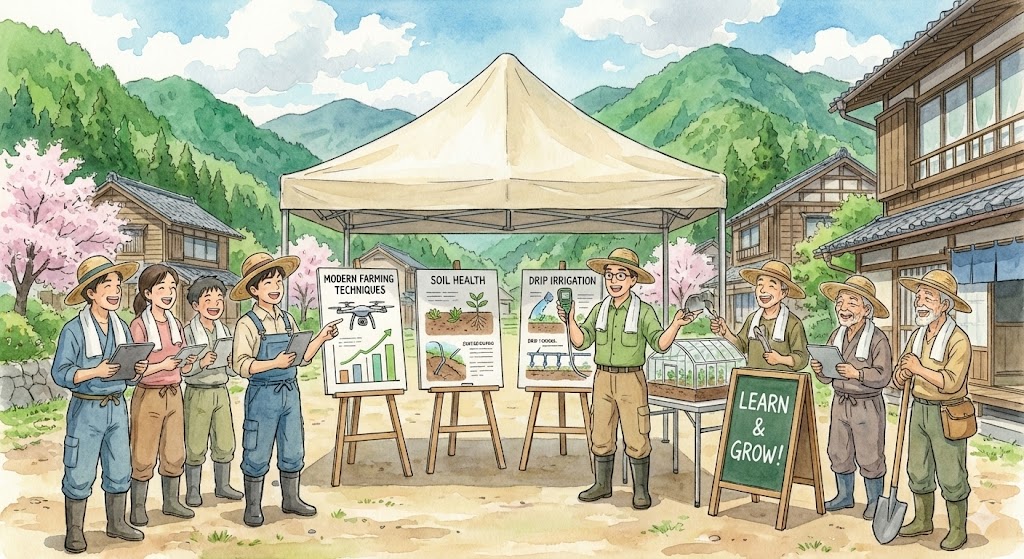
➡️ Below are the key points explaining government training programs for agricultural skill development.
🔵 1️⃣ ➡️ Types of Training Programs
➡️ Government training programs cover a wide range of agricultural skills, including crop production, organic farming, horticulture, animal husbandry, fisheries, and agro-processing. Specialized courses focus on modern technologies such as precision farming, drip irrigation, greenhouse cultivation, and soil health management. Some programs also emphasize entrepreneurship skills, marketing strategies, and financial literacy for farmers. These programs can be short-term workshops, long-term certification courses, or hands-on practical training. By offering diverse training types, governments ensure that farmers from various backgrounds and with different levels of experience can benefit. This helps in bridging the knowledge gap and introducing innovative methods to improve productivity and income.
🔵 2️⃣ ➡️ Eligibility and Enrollment Process
➡️ Most government agricultural training programs are open to farmers, agricultural students, rural youth, and farm workers. Eligibility criteria may include age limits, educational qualifications, and proof of involvement in farming activities. Enrollment is usually done through online portals, local agricultural offices, or government agriculture universities. Some programs are free, while others may require nominal fees or subsidies. Farmers must provide necessary documents, such as land records or identification proofs, to participate. Easy enrollment and clear guidelines ensure wider participation, enabling farmers across regions to access skill development opportunities and improve their agricultural practices effectively.
🔵 3️⃣ ➡️ Skills and Knowledge Imparted
➡️ Training programs focus on equipping farmers with practical and theoretical knowledge. Topics include crop selection, soil fertility management, irrigation techniques, pest and disease management, post-harvest processing, storage methods, and sustainable farming practices. Farmers also learn about the use of modern equipment, farm mechanization, and digital tools for farm management. In addition, some programs teach financial planning, market linkages, and entrepreneurship skills, helping farmers enhance income through value addition. Such comprehensive skill development ensures farmers are better prepared to face challenges, adopt innovative methods, and increase productivity while minimizing costs and losses.
🔵 4️⃣ ➡️ Support and Resources Provided
➡️ Government training programs often provide resources to facilitate effective learning. These may include access to demonstration farms, modern tools, reference materials, online tutorials, and expert guidance. Some programs also offer mentoring by experienced agricultural scientists or extension officers. Farmers may receive financial assistance, subsidies for equipment purchase, or seeds and fertilizers to apply newly learned techniques. Supportive resources ensure that farmers can implement their knowledge practically on their farms. Continuous guidance and hands-on training help reinforce learning, leading to better adoption of modern agricultural practices and improved farm management.
🔵 5️⃣ ➡️ Benefits and Impact on Farmers
➡️ Participation in government training programs has a significant positive impact on farmers. Skilled farmers can increase crop yield, reduce input costs, improve farm efficiency, and enhance profitability. Adoption of sustainable and modern techniques promotes soil health, water conservation, and environmental protection. Additionally, trained farmers gain confidence in using technology, managing risks, and exploring new income opportunities, such as agribusiness and organic farming. Knowledge sharing within communities also helps in spreading innovative practices. Overall, these programs empower farmers, improve livelihoods, and contribute to the development of a more productive, sustainable, and resilient agricultural sector.
➡️ CONCLUSION
➡️ Government training programs for skill development in agriculture play a vital role in empowering farmers with knowledge, techniques, and confidence to improve productivity and income. By offering practical and theoretical guidance, modern tools, and continuous support, these programs enable farmers to adopt sustainable and innovative farming practices. Participation in such training not only enhances crop and livestock management but also encourages entrepreneurship and better market access. Farmers equipped with updated skills can maximize their resources, reduce risks, and achieve long-term success. Promoting awareness and enrollment in these programs ensures a skilled and resilient agricultural workforce, contributing to sustainable growth and food security.